“Even Republicans Move to Rein in Trump’s Unilateral Course” U.S. House Passes Resolution to Halt Iran War, Shaking Trump’s Political Momentum

Authored On
Modified
Four Republicans Ultimately Break Ranks with Trump
No Binding Force in Practice, Largely Symbolic in Nature
Trump Also Searching for an Exit Rather Than Escalation
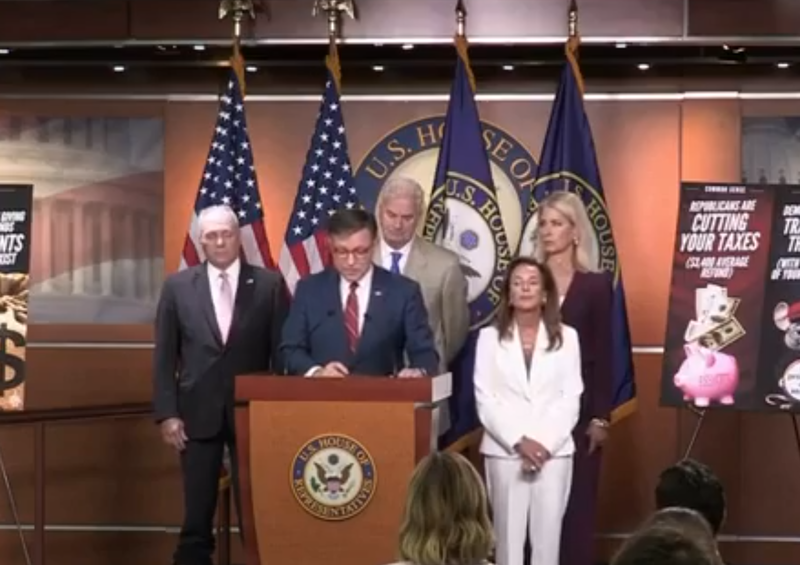
A War Powers Resolution designed to prevent U.S. President Donald Trump from continuing military operations against Iran without congressional approval has passed the House of Representatives. It marks the first time since the outbreak of the Iran conflict that Congress has approved a measure aimed at restricting Trump’s authority over military operations. While the resolution remains largely symbolic because the president can veto it, growing public concern over further escalation—even within Congress—has increased the political pressure facing Trump.
Bipartisan Check on War Powers: 215–208 Vote
According to The Washington Post (WP) on June 4 (local time), the U.S. House of Representatives approved the War Powers Resolution introduced by Democratic Representative Gregory Meeks by a vote of 215 to 208 during a plenary session the previous day. The resolution requires the withdrawal of U.S. forces engaged in hostilities against Iran unless such actions are necessary to defend the United States, its allies, or partner nations from an “imminent attack,” and unless Congress provides authorization.
Democrats and supporters of the resolution emphasized that the constitutional authority to declare war resides with the legislative branch rather than the president. They warned that the conflict could evolve into a prolonged war without a clearly defined exit strategy and argued that the conflict was placing additional pressure on household finances through rising prices for oil, food, and other necessities.
Several similar resolutions have previously been brought before both chambers of Congress but were consistently blocked by Republicans, who hold the majority. However, four Republican lawmakers—Thomas Massie of Kentucky, Brian Fitzpatrick of Pennsylvania, Tom Barrett of Michigan, and Warren Davidson of Maine—joined Democrats in supporting the measure, reversing the outcome. In the Senate, a separate anti-war resolution had narrowly cleared a procedural vote last month and was awaiting a final vote. The House measure, however, became the first to secure passage.
Since the outbreak of the conflict, Democrats have repeatedly introduced war powers resolutions in both chambers. According to a joint New York Times–Siena College poll, 64% of registered voters said Trump’s decision to engage in the war was wrong, while only 30% viewed it favorably. Under the War Powers Act of 1973, the president must notify Congress within 48 hours of committing U.S. forces to hostilities and must terminate those operations within 60 days absent congressional authorization. The law permits an additional 30-day withdrawal period to ensure the safe redeployment of U.S. troops, effectively setting a 90-day deadline that expired on May 31. Trump, however, has argued that the requirement no longer applies because “hostilities have terminated” following the ceasefire.
Uncertain Legal Force Even if Senate Approves, Essentially a Political Pressure Tool
Even so, the resolution does not immediately restrict Trump’s authority. The measure passed by the House is a concurrent resolution expressing the position of Congress rather than a legally binding joint resolution requiring presidential approval. While it does not require the president’s signature, it also carries no legal force. The separate anti-war resolution currently pending in the Senate is a legally binding joint resolution, but it must first pass the Senate before returning to the House for another vote.
Even if both chambers approve it, Trump would still need to sign the legislation, and he is widely expected to veto it. Overriding a presidential veto would require a two-thirds majority in both the House and Senate, a threshold considered highly unlikely in the current climate of intense partisan division. In practical terms, the resolution is unlikely to constrain Trump. A White House official emphasized the point, stating, “This House concurrent resolution cannot reach the president’s desk. Even if a Senate version passes, it carries no legal effect.”
Nevertheless, the fact that some Republicans joined Democrats in supporting limits on military action against Iran carries considerable political significance. It reveals cracks within the president’s own party over his hardline Iran strategy. War powers have long been one of the most sensitive constitutional issues in Washington. While the president serves as commander-in-chief, Congress retains the authority to authorize war and control appropriations. Successive administrations have broadly interpreted presidential powers in responding to terrorism and overseas conflicts, while Congress has repeatedly attempted to reassert its authority through the War Powers Act.
Trump’s military campaign against Iran has generated the same debate. Since launching military operations against Iran in February, the United States has heightened tensions across the Middle East. Trump has justified the campaign by citing Iran’s nuclear ambitions and regional threats, but criticism has grown within Congress over what many lawmakers view as prolonged military involvement without explicit authorization. The latest vote is significant because it transformed that dissatisfaction into actual defections. Although Republican leadership opposed the resolution, several Republican lawmakers concluded that they could no longer provide Trump with a blank check. They argued that the administration had failed to adequately explain either the objectives of the conflict or the extent to which confrontation with Iran might escalate. Democrats, meanwhile, framed the measure as an effort to reclaim Congress’s constitutional authority. With the resolution passing a Republican-controlled House, the Trump administration now faces greater pressure to justify any further expansion of the conflict.
For Trump, the broader trend may be more concerning than the vote itself. Last month, a similar resolution failed in the House by a 212–212 tie. At that time, it fell short of a majority. This time, however, Republican defections changed the outcome. Within just a few weeks, congressional sentiment shifted against the president. Fatigue over the prolonged confrontation with Iran is also growing both domestically and internationally. Middle East tensions have direct implications for oil prices, inflation, and the safety of U.S. troops. Republican lawmakers facing midterm elections in November are increasingly sensitive to those concerns. Openly challenging Trump remains politically difficult, yet continued support for a war with no visible endpoint is proving equally problematic.

Trump Abandons Option of Renewed Full-Scale War
Although the resolution is unlikely to acquire legal force, many observers believe it is sufficient to increase pressure on Trump. The president already appears to have stepped back from the option of renewed large-scale bombing. According to The Wall Street Journal (WSJ), Trump recently told advisers that he would not resume full-scale war against Iran unless U.S. military personnel were killed. By making American casualties the threshold for ending the ceasefire, he effectively signaled a willingness to tolerate limited clashes that fall short of that line. Indeed, Trump appeared to adopt a relatively restrained stance on June 3 regarding attacks on neighboring countries attributed to Iran. Asked by White House reporters about the Kuwait attack, he responded that “everything happens for a reason,” while noting that the United States had recently inflicted substantial military damage on Iran. “They responded,” he added.
Trump’s objective appears clear: preserving the negotiating process. Asked whether the ceasefire agreement between the United States and Iran remained valid despite Iran’s attack on Kuwait, Trump replied, “I hear the negotiations are going very well,” adding that a deal “could happen as early as this weekend.” His direct involvement on June 2 in mediating a ceasefire between Israel and Hezbollah, the Iran-backed Lebanese armed group, further underscored his commitment to reaching an agreement. The U.S. State Department announced in a joint statement on June 3 following talks held in Washington under U.S. mediation that Israel and Lebanon had agreed to implement the ceasefire.
The challenge, however, is the steady erosion of negotiating leverage. Representative Michael McCaul (R-Texas) argued that passage of the resolution would “weaken the president’s leverage in negotiations with Iran.” Trump has been pressing Tehran to make additional concessions, including on the disposition of its stockpile of highly enriched uranium (HEU). Iran, meanwhile, maintains that it will not engage in denuclearization negotiations without economic compensation from Washington, including the release of frozen assets. The crisis surrounding the Strait of Hormuz, now in its fourth month, is also approaching a critical point. U.S. crude oil inventories have reportedly fallen to their lowest level in 22 years. Analysts have warned that futures markets are underestimating the energy supply risks posed by the Iran conflict and that global oil inventories could tighten sharply within the next two to three weeks, potentially triggering a significant surge in crude prices.
Similar Post