Why AI Detection Is Failing Higher Education

His recent work examines the broader socioeconomic consequences of artificial intelligence, including labor markets, public finance, demographic change, institutional adaptation, and the distributional effects of technological progress.
He holds a PhD in Mathematical Finance from Boston University, and previously earned an MSc in Finance and Economics from the London School of Economics. He completed his undergraduate studies in Economics at Seoul National University under the Korea Foundation for Advanced Studies scholarship program.
Published
Modified
AI detection software failed; universities scrap it for coaching
Same policy mistakes as plagiarism era are repeating, faster
Process-based evaluation beats unreliable detection percentages

Less than one in four American universities has a formal written policy on the use of artificial intelligence by its students. The number comes from recent research that shows how slowly the institutional apparatus is moving in the face of a technology that has already become a daily habit in classrooms. At the University of Nevada at Reno, the administration tried the usual answer: artificial intelligence detection software, built into the same system it used to check for plagiarism. The result was no less use of artificial intelligence. It was more stress, more unwarranted accusations, and no improvement in learning. The university eventually abolished the tool entirely. This story is not an isolated case, but one indication that AI detection, as a strategy is failing as an institutional strategy.
Universities Are Repeating the Plagiarism Playbook
The history of plagiarism offers a cautionary precedent for what is happening now. For a decade, plagiarism policies were based on three assumptions that were proven wrong: that copying was a moral failure and not a developmental stage, that a uniform standard of acceptable help could be applied fairly to students with very different resources, and that software could rule on someone's guilt. EFL instructor Özgür Çelik describes how students who wrote in a second language were reported for academic misconduct at a rate two to three times higher than native speakers, even though actual misconduct rates did not differ significantly. The problem did not lie in their behavior. It lay in who attracted the suspicion of invigilators.
Çelik doesn't stop at diagnosis. She proposes four lessons drawn from a decade of plagiarism policy: explicitly state what exactly is evaluated in each paper, test every rule against a student who writes in a second language rather than an imaginary native speaker, never allow a percentage probability from a detector to act as standalone evidence, and evaluate the writing process itself through drafts and revisions, not just the final text. These proposals are not just for second language students. They outline a more general principle of policy design that universities ignored once and are in danger of ignoring again.
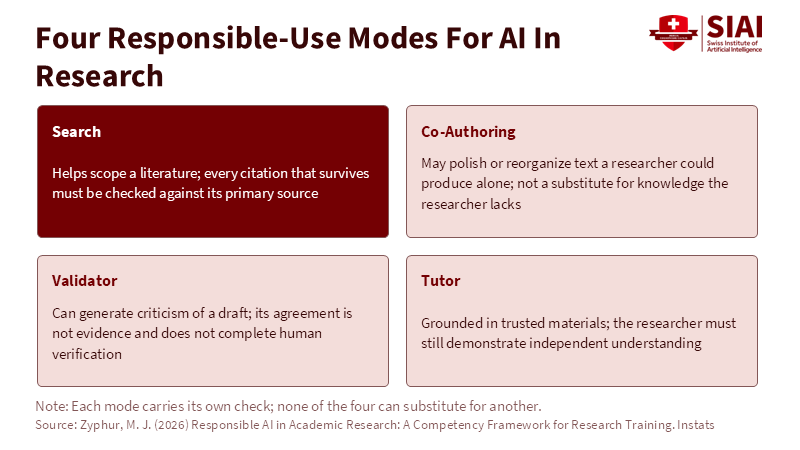
Universities are now writing AI policies in the same way, only faster and on a larger scale. Researcher Michael Zyphur examined the public policies of thirty-eight leading doctoral universities in fifteen countries, along with fourteen funding bodies and eighteen publishing houses, and found that only six institutions had gone beyond integrity and disclosure of use to real-world AI usage knowledge, supervision, and authoritative research practice. Fifteen institutions remained at the level of a general norm of student conduct. Seventeen had advanced integrity and reproducibility issues, but without codified competency expectations for researchers. The finding confirms the same pattern already recorded in plagiarism: the rules focus on the surface of the text rather than on the judgment that produced it, and the very structure of the problem is repeated from teaching to research. Zyphur’s framework helps clarify what most institutional policies still miss: responsible AI use in research is not a single rule, but a set of distinct modes, such as search, co-authoring, validation, and tutoring, each requiring its own form of human judgment and oversight.
Why AI Detectors Fail as Evidence
The technical weakness of AI detectors is no longer in question. A test conducted in 2023 on a newer generation of detectors found that no tool exceeded eighty percent accuracy, while several characterized human text as a machine product, and vice versa. The same team of researchers had already tested, three years earlier, the corresponding plagiarism detection tools in a multinational evaluation and had found huge discrepancies in what each detected; none could responsibly substitute human judgment. The tools functioned as aids, not juries, but institutions used them as if they were the latter. Stanford University researchers found something even more troubling: GPT detectors incorrectly classified four lessons drawn from a decade of plagiarism policy written by non-native English speakers as AI products, while judging native speakers' essays almost flawlessly. The limited lexical richness and predictable syntax of a non-native speaker were interpreted by the detector as a sign of machine output, not a feature of language learning.
At the University of Nevada, Executive Vice President and Provost Jeffrey Thompson describes how this unreliability turned the tool into a source of fear instead of a teaching aid. Students felt anxious about being wrongly accused, while professors found themselves caught between two dangers: if they didn't use the software, they risked ignoring actual AI use; if they did, they risked punishing innocent students. The institution had already moved from the era of simple plagiarism detection software to an era where the line between human and machine writing had become blurred, and the old tool could no longer cope with the new reality.
As part of a broader initiative to integrate AI into teaching and research, the university ultimately chose to ditch the detection tool and partner with a writing guidance platform, which accompanies the student throughout the process rather than just checking them at the end. The change didn't mean disregarding integrity. It meant acknowledging that policing a text doesn't reveal anything about how the thinking behind it was produced. Thompson cites a recent survey showing that less than a quarter of U.S. institutions of higher education have a formal policy on the use of AI, which explains why so many institutions still rely on detection tools despite their documented problems.
From AI Policing to Cognitive In-Sourcing
The alternative is not unlimited use of AI without any conditions. It is instructional design that holds cognitive effort in the hands of the student. Neuroscientist Adam Green, from Georgetown University, and clinical neuropsychologist Jared Benge, from the University of Texas at Austin's Dell Medical School, describe AI as a tool that can free up mental space or empty it completely, depending on how it is used. Both recommend a simple step before any question in a conversational system: first record one's own thought, and only then ask the AI to improve or challenge it.
A survey of three hundred and nineteen knowledge workers, with nine hundred and thirty-six recorded incidents of generative AI use, found that critical thinking was activated, according to the participants' own reports, in about six out of ten incidents. The finding that matters most concerns the relationship with trust: the more confident someone felt about the AI's ability to complete the task, the less critical thinking they reported engaging in. Trust in personal judgment was instead associated with more, not less, critical engagement. The conclusion is not that AI automatically harms every user's thinking. It's that the degree of trust in the tool, not its very existence, ultimately determines whether someone thinks less.
Green himself predicts that the habit of "thinking outside of robots" will gradually become a natural survival strategy in a world where text production is no longer evidence of human thought. This observation is of direct relevance to lesson design: if the value of a human idea lies in its specificity, then a task that only rewards the fluency of the final text rewards precisely the characteristic that artificial intelligence reproduces best. Teaching that asks the student to defend a personal choice, even an imperfect one, trains the same skill that the job market will reward.
Redesign Assessment Around Process and Judgment
For teachers, change means replacing the question of who wrote a text with asking what the student can explain about their own work. Exercises that require drafts, intermediate texts, and verbal defense of choices reveal judgment in a way that a final text can no longer reveal. For administrators, it means investing in guidance tools instead of detection tools, as well as training the professors themselves, who cannot teach disciplines that the educational environment itself does not demonstrate every day. For policymakers, it means making an explicit distinction between tasks that AI can accelerate and judgments that must remain human, as suggested by the five-dimensional framework developed by Zyphur for research education. The same framework suggests something that is often omitted from student discussions: providing tools with criteria so that the institution can check whether an AI system offers verifiable citations, clear uncertainty information, and auditable usage trails, rather than leaving tool selection solely to the discretion of each individual professor or student.
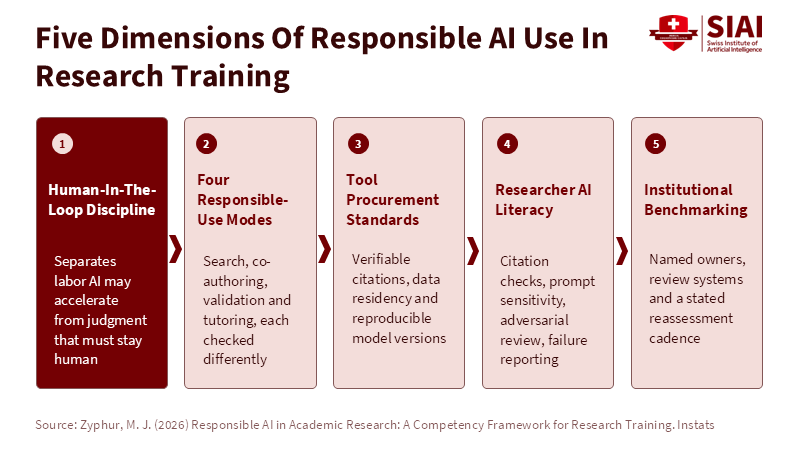
One expected objection is that abolishing detection will pave the way for rampant fraud within classrooms. The evidence does not support this fear. Detection tools did not fundamentally prevent dishonest use; they simply shifted the burden to the wrong targets, more often punishing students with different language backgrounds than their fellow students. Evaluating the process, rather than just the final product, offers a stronger proof of integrity than any probability percentage an algorithm produces. The same conclusion emerges from Zyphur's research: the reproducibility and transparency of the process, not the prohibition of a useful tool, ultimately protect academic credibility.
A second objection concerns scale: many institutions teach thousands of students per semester and do not have the staff to read drafts, intermediate texts and oral explanations for each assignment. This objection has a factual basis, but ignores the cost of the alternative. Staff who currently manage miscategories, student appeals and institutional investigations around unreliable probability rates could be channeled into course planning and targeted feedback. Shifting resources, not increasing them, is what the system needs.
The one in four universities with a formal AI policy isn't just a statistical gap. It's an indication that the industry is still wondering if it should ban something that's already embedded in the daily work of its students. The University of Nevada showed what happens when an administration admits that the detector didn't protect anything substantial: less fear, more actual teaching, and a relationship of trust between faculty and students that the software had already silently eroded. Institutions that still invest in AI detection are investing in a tool that research itself has already discredited with evidence. The next generation of policies needs less reliance on detectors and more teachers ready to ask the student how he thought, not which tool he opened on his computer screen. Those institutions that move in this direction first will not have to rewrite their policy in a few years, when the next generation of tools makes today's detectors even more obsolete than they already are today.
This article reflects the analytical judgment of the author and does not constitute policy advice or the official position of any affiliated institution.
His recent work examines the broader socioeconomic consequences of artificial intelligence, including labor markets, public finance, demographic change, institutional adaptation, and the distributional effects of technological progress.
He holds a PhD in Mathematical Finance from Boston University, and previously earned an MSc in Finance and Economics from the London School of Economics. He completed his undergraduate studies in Economics at Seoul National University under the Korea Foundation for Advanced Studies scholarship program.